


One minicamp into his Cardinals career in 2005, Kurt Warner was already rightfully intrigued by Larry Fitzgerald’s talent.
The quarterback let the second-year wide receiver know that he thought Fitzgerald was pretty good. He also believed, with work, Fitzgerald could be great, and over a meal, Warner told Fitzgerald as much. Except to that notion, Fitzgerald said to Warner, “I’m good.”
Fitzgerald had flashed plenty as a rookie in 2004, even as the Cardinals ended up starting three different quarterbacks. He had been spectacular in college at the University of Pittsburgh, good enough to be a Heisman finalist (and perhaps the most deserving of the award) as well as the third overall pick in the draft.
He could be more, though. Warner saw that quickly. And while it took some prodding early on, soon too did Fitzgerald.
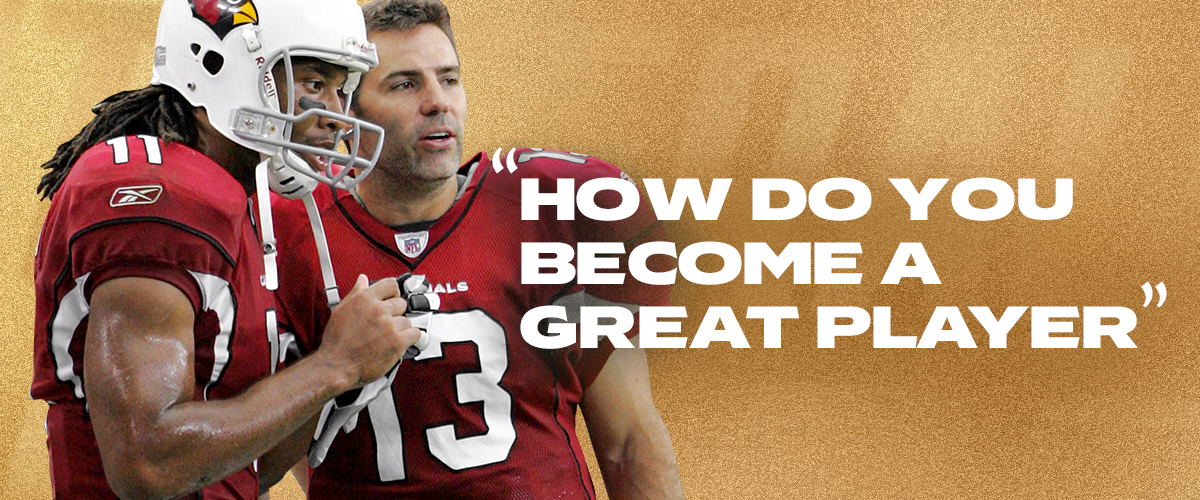
“When I got here, it was ‘OK, you are physically talented. But how do you become a great player?’” Warner said. “You can jump over somebody or make a one-handed catch, but there is so much more that goes into being a great player. You tie that into the physical side of that, and you’ll be one of the best ever.”
Fitzgerald bought in, to where he eventually was voted to the NFL 100 team, made up of the 100 best players in the league's history. He made 11 Pro Bowls, is second in NFL history in receptions (1,432) and yards (17,492) and owns an NFL-record eight seasons with at least 90 catches.
When the Cardinals did win, Fitzgerald was often the engine, whether it was his epic 2008 postseason performance or his overtime “Hail Larry” efforts in 2015 against the Packers in the playoffs.
“You get in the league, you’re immensely talented, but you don’t have any experience, right?” Fitzgerald said. “There are a lot of things you don’t know how to do.
“What you hope is when you get to your peak, you’re able to stay there at that peak performance for a long period of time.”
“What you hope is when you get to your peak, you’re able to stay there at that peak performance for a long period of time.”
Fitzgerald was mostly peak for 17 seasons. That’s why he’s being inducted into the Pro Football Hall of Fame on Saturday.

THE BEGINNING
The Cardinals were in Miami halfway through Fitzgerald’s rookie season in 2004, finding themselves trailing with 90 seconds left in the game. For the first time of many, the Cardinals leaned on their new toy.
It was a 48-yard pass from quarterback Josh McCown to Fitzgerald that got the Cardinals down inside the Miami 5. Then came a harbinger for the next 17 years.
“We’re going in the huddle and, and he was like, ‘Josh, I'm going to catch it,’” McCown recalled. “The only question was if I was going to throw it to him, because there was not a question of what the result would be if I did.”
McCown threw the jump ball to Fitzgerald from the 2-yard line, Fitz outleaped defender Reggie Howard, and with 19 seconds left, the Cardinals had a 24-23 win to break a 17-game road losing streak.
“That cemented it for me,” McCown said. “That was probably the moment. That was the first moment where it was like a clutch moment for him. For him to go in the huddle and say, ‘I'm going to catch it.’ That kind of defines Larry. He just wanted a chance to impact the game.”
When Fitzgerald first showed up to Arizona, it was a few days late, his first contract negotiation delaying his training camp debut. He hadn’t yet turned 21. In one of his first 7-on-7 drills, he got whacked under the chin by third-year safety Adrian Wilson, who told his new teammate to “get your ass off the ground.”
His father had been close with Cardinals coach Dennis Green when Green coached in Minnesota; Fitzgerald had famously been a ballboy with the Vikings and saw what Hall of Fame receiving looked like with Cris Carter and Randy Moss.
Carter, also friends with Fitzgerald Sr., mentored Larry for a number of years before college, remembering a teen who was quiet.
“It was really about maximizing the moment God had gifted him,” Carter said. “Was he going to take advantage? These are the schools, these are opportunities, but if you don't take care of this high school stuff and create some discipline for yourself, you're not going to be able to take advantage.”
The Carter relationship was the first of many Fitzgerald developed to help him on his way. Inquisitive his whole life, Fitzgerald first asked questions of Carter. Once in the NFL, it was the veteran Warner, with whom Fitzgerald bonded quickly when Warner signed in 2005. Fitzgerald was teammates with wide receiver Anquan Boldin, who himself was NFL Offensive Rookie of the Year in 2003 but brought with him a maturity well beyond his age.
“I think I helped him with some mental parts of the game, but honestly he had to go out on the field, and he had to make the plays, he has to make the catches,” Boldin said. “All of that was on his shoulders, and he put in the work.”
From his first NFL catch, a 37-yard leaping grab in double coverage against the Rams (and former Cardinal Aeneas Williams) from McCown, Fitzgerald’s talent showed. He was exceptional, which is why he told Warner he didn’t think he needed much more.
It wasn’t that Fitzgerald didn’t want to be great. He just didn’t know quite how to get there yet.
“Looking back in retrospect, you’re always like, ‘Man, I wish I would’ve been doing this, I wish I would’ve thought about that,’” Fitzgerald said.
Warner’s arrival was important. The quarterback was deep in his career, 12 years older than Fitzgerald. But he was owner of a Super Bowl MVP and the knowledge of how to get a team there, and Warner and his wife Brenda welcomed Fitzgerald into their world.
Fitzgerald’s second season – with Warner starting 10 games before he was hurt – was his statistical breakout, with 103 catches for 1,409 yards and 10 touchdowns.
“Even though we were in different places in our career of how we wanted to do our job, we both wanted to be really good at our job,” Warner said. “It naturally lent us to having those conversations and working on the field and me not being afraid to call Larry out or to challenge him on certain things and him not afraid to ask me questions. He didn't have all the answers at that point.”
Practice was never the problem. Fitzgerald loved practice. He cherished being out there playing a sport he loved with 60 friends. But he was also pragmatic. If he was going to be on the grass, he figured, “I’m here, why wouldn’t I get better?”
Everyone Fitzgerald played with, from his early pre-Super Bowl days to late career, marveled at the plays he made in practice. It wasn’t just the effort he gave. It was the production, stabbing passes at times that multiple people insisted were better plays than what he’d make in games.
“I can’t tell you how many times I’d tell Larry, that was a great play or that was a great game,” former general manager Rod Graves said, “and he’d look at me with this sincere look of concern and say, ‘Mr. Graves, I’ve got to get better.’”

THE ASCENSION
Chris Harris played safety for the Carolina Panthers in 2007 and 2008, right as Larry Fitzgerald was reaching his prime. The Cardinals and Panthers played each other three times in those two seasons, including the epic Divisional Playoff win the Cardinals posted in Charlotte on their way to the Super Bowl.
Fitzgerald was a nasty opponent to face, Harris acknowledged. But only in the way he damaged defenses with his play.
“You could try to get under his skin, you could talk as much trash as you want to,” Harris said. “He's going to ask you about your family, how your kids doing, like that was that was who he was as a player. He laughed, pat you on the butt, keep it pushing.
“I mean, it's frustrating, when you're talking to a guy and he’s just … nice. He's really a nice human being. That is who he is to his core.”
The arrival of Ken Whisenhunt as coach in 2007 and the firing of Green after the 2006 season were hard on Fitzgerald. “It took a toll on me,” he said a decade later. He had felt the pressure of succeeding for Green, who had been one of the biggest proponents of drafting him.
But the team was on the brink of challenging for the playoffs, and it started with Fitzgerald and Boldin as their offensive stars.
Whisenhunt and offensive coordinator Todd Haley joined Warner in pushing Fitzgerald. Haley famously called Fitzgerald a “one-trick pony” who was all about grabbing jump balls down the field and not worrying about much else. The coaches pushed Fitzgerald to use his 6-foot-3, 220-pound frame to bull over defensive backs and earn more yards after the catch.
Fitzgerald took it to heart.
In 2008, the Cardinals made their magical run to the Super Bowl. They had three 1,000-yard receivers in the regular season, with Fitzgerald, Boldin and second-year wideout Steve Breaston. Warner was magnificent.
But it was Fitzgerald who stormed the country’s collective consciousness. The Cardinals were called by analyst Cris Collinsworth the worst playoff team ever, but Fitzgerald hoisted the team on his back with arguably the greatest individual postseason performance ever.
“I think we all had the sense that Larry had taken a long time to get there,” Warner said. “He didn't know when he was going to be back, and he was going to make the most of it, and he was locked in like we had never seen him locked in before. It was just fun for all of us to be along for the ride.”
Breaston – who despite coming into the league three seasons after Fitzgerald was actually 11 days older – admitted he didn’t understand why the Panthers didn’t take away Fitzgerald after Fitz had his six catches for 101 yards and a touchdown in the Wild Card game against the Falcons. (Especially with Boldin down with a hamstring injury.) He didn’t understand why the Eagles didn’t focus on Fitz after he went 8-166-1 against the Panthers. In the Super Bowl, the Steelers did try and take him out after his 9-152-3 NFC Championship game, but Fitz came alive in the fourth quarter (finishing 7-127-2) and nearly carrying the Cards to a title.
“I was turning around, it's like, ‘Oh, they leaving him (open),’” Breaston said. “You would think they would take him away, especially with the season he was already having.
“But you know, in the same breath, Kurt threw the jump ball in Carolina and there were people all over him and he caught it anyway. So maybe it didn’t matter what happened.”

Harris, who made a desperate late dive at Fitzgerald to try and prevent Fitzgerald’s diving-at-the-pylon TD in the Carolina playoff game, simply remembered a player who wasn’t going to be stopped.
“He was playing lights out,” Harris said. “I mean, I was about to say he was catching everything, but he doesn't drop the ball anyway. He was just running through tackles, going up and making contested catches. It didn't matter. You got two guys on them. It didn't matter.”
You got two guys on them. It didn't matter.
Fitzgerald shakes his head about being “in the zone” at the time, although he acknowledges he was indeed there. If it happens, he said, it only happens for a short while and every player needs to have that perspective. Once, a former 49ers executive told Fitzgerald that Jerry Rice, a week after dominating in a Super Bowl and winning MVP, was back on the field practicing his route running.
That’s how Fitzgerald approached his post-2008, and his whole career.
“(Rice) was unquestionably the best player in the game, doing historical things, and he was never satisfied,” Fitzgerald said. “That mindset was one I tried to adopt and focus on, because I always tell people, there's a difference between being a hunter and being hunted. Everybody's looking to you to come take it from you, and so I always wanted to kind of have the mentality of somebody who was being hunted.”
Fitzgerald and the Cardinals didn’t win the Super Bowl, but he was now a guy getting a phone call from President Barack Obama, getting on the cover of the Madden NFL video game, and making All-Pro. He had become the face of the franchise.
“What was special about Larry, and it was not lost on us, when we were doing his contracts … he was more than a regular player,” Graves said. “He was an ambassador. He was an ambassador for our team, an ambassador for the league. We were dealing with a once-in-a-(GM)-career type of player. We were focused on him retiring as an Arizona Cardinal.
“We knew there was a heavy price to pay (monetarily) for that, but he brought such joy and excitement, class, to the organization that in my opinion, he was worth every dime he got out of football.”

THE BRIDGE
John Skelton was a rookie in 2010, a fifth-round quarterback drafted on the heels of Warner’s retirement. Matt Leinart was the QB-in-waiting, and the Cardinals had signed veteran Derek Anderson as a backup. Skelton was trying to hold off undrafted Max Hall to make the team, not necessarily thinking about throwing passes to arguably the best wide receiver in the game at the time.
“You kind of get a little starstruck with some of the guys that you're now teammates with, Larry being at the top of that list,” Skelton said.
The equation had changed quickly. Boldin was also gone, having been traded to Baltimore. The Whisenhunt-Leinart marriage never worked, and the Cardinals released Leinart at the end of the preseason. Anderson was the starter, but suddenly, Skelton and Hall were getting reps with No. 11.
“It was real early that I got to see Larry up close and see how special he was,” Skelton said. “The level of professionalism that he brought was always really impressive to me. I think what makes Larry … he's not the fastest guy in the world, he's not the best route runner, he sometimes could get a little lost in space with a certain play. But when the lights are on and you need a big play, you throw it anywhere in Larry's vicinity and he's going to come down with that ball.”
The three seasons between Warner and Carson Palmer did not provide stability at quarterback. Despite the trade for Kevin Kolb in 2011 to solve for QB1, Kolb’s injuries prevented it as an answer. Fitzgerald caught passes from Kolb, Skelton, Anderson, Rich Bartel, Brian Hoyer and Ryan Lindley in those years, and was still able to generate two 1,000-yard seasons, including his most efficient year in 2011 (a career-best 17.6 yards a catch, with 1,411 yards on 80 receptions.)

“He was upset at times because we weren't as effective as we had been,” Whisenhunt said. “We were working on quarterbacks and all kinds of things like that. The one thing that I really admire about Larry the most is that he worked hard in practice. That was what really allowed him to be so successful was because he knew how to put in the work.
“He was frustrated at times. I'm sure as all our fans were. It wasn't as smooth as it had been, but Larry still found a way to make plays, still found a way to score points, and he became one of our best leaders.”
Fitzgerald never complained. That wasn’t his way. The noise outside got loud at times – Fitz’s best years are being wasted! Send him to a different team! – but he worked with Skelton and anyone else throwing him passes and tried to find a path to succeed.
“I just wanted, when you put on the tape, you saw that I was doing my job to the best of my ability and the thing that would give (quarterbacks) confidence is if I made plays for him,” Fitzgerald said. “So make a one-handed catch, or dive for a play in practice, whatever I needed to do.”
Wide receiver is a funny position. You can be the greatest at it, but it’s the one spot where a football player is almost entirely dependent on others to make the greatest impact. In 2012, only 45 percent of throws targeted to Fitz were completed (the lowest of his career) and his numbers dropped, but he still reached the Pro Bowl. It wasn’t as if his hands had diminished.
“He didn’t let any of the obstacles get to him,” said Jerry Sullivan, the two-time Cardinals receivers coach/coordinator who started working with Fitzgerald in various offseasons beginning in 2011. “He knew if you’re good enough, you don’t have to stand up on a soapbox and tell everybody.
“They’ll already know.”
“They’ll already know.”

THE RESET
Fitzgerald just wanted to be the “X.”
He had been the “X” receiver his whole NFL career. His whole life. Outside, near the sideline, little to do but focus on the cornerback across from him. But now it was 2013, Bruce Arians had replaced Whisenhunt as coach, and as great as Fitzgerald was, Arians saw him as something different. He wanted to transform Fitzgerald into an inside receiver, a guy who would run shorter routes, who could use his big frame to block and who could feast on mismatches with linebackers even though -- almost a decade into his career -- he might not win such situations against younger cornerbacks.
Arians’ pitch was that he made similar moves with Hines Ward in Pittsburgh and Reggie Wayne in Indianapolis, to excellent results.
“It wasn't easy, but it wasn't that difficult,” Arians said. “Larry had a lot of pride. It was getting him out of his comfort zone and, you know, great players don't like that.
“But he bought in whole-heartedly. I told him, ‘Dude, I'll guarantee I'll get you a 100 balls.’ And when I design stuff in a red zone, I design it for you. If you block, we'll make sure you get touchdowns. He said, ‘I’m all for that.’”
And so Fitzgerald moved. The first half of the 2013 season was hard, the transition anything but smooth. But he ended up as arguably the best blocking wide receiver in the NFL (much to his chagrin). And while it took a couple of seasons, he ended up with three straight years of more than 100 catches for the first time in his career.

“In hindsight, I’m glad it happened,” Fitzgerald said. “Out of all the things that happened in my career, that was the thing I was happiest about. When you have a lot of success you begin to think the way you’ve always done it is always the way it should be done.
“The one thing that’s constant in life, even for me now, is change. If you’re not willing and able to adapt, you’ll be left behind. Yes, I was frustrated initially. I feel like I handled it professionally. I was coachable, not that I had any choice. (Arians) made me a better football player.”
Carson Palmer’s arrival didn’t hurt either. The veteran quarterback settled the position for the first time since Warner left, and the Arians offense took off. The Cardinals won at least 10 games for three straight seasons and reached the NFC Championship game in 2015.

“There were some growing pains,” Palmer said. “I was going through some of my own. But Bruce treated us like pros, and it was our job to figure it out. Larry worked really hard until he figured it out.
“It’s not a surprise. I walked in the door and knew there was a future Hall of Famer in our locker room.”
“It’s not a surprise. I walked in the door and knew there was a future Hall of Famer in our locker room.”
There was more to do. Fitzgerald would have to focus on option routes and reading what the coverage told him to do. There was relaying calls to the outside receivers at the line of scrimmage, whereas he once just had to listen for those calls.
Then there was the blocking. He never had to do much of it – Whisenhunt said Fitzgerald always gave good effort in that area of the game – but with the shift under Arians a decade into his career, Fitzgerald became great at it.
Just don’t tell him that. He shrugged it off when he was playing, and the new Hall of Famer still doesn’t love the idea.
“If you tell an NBA guy that he’s a great defender, he’d be like, ‘OK, but that’s not really cool,’” Fitzgerald said. “You want to score buckets. It’s part of why you win as a team. But do you want to be known as a great blocker, or do you want to be known as a great pass catcher? I’m glad I could impact the game even when the ball wasn’t in my hands.”
The B.A.-Fitzgerald team-up reached its zenith in 2015, when the Cardinals won the NFC West at 13-3 and then played the Packers in a memorable Divisional Playoff game. The Cardinals won, 26-20, in overtime and Fitzgerald revisited his playoff greatness with a career-best 176 yards.
Included in that was his OT two-for, first coming up with his “Hail Larry” 75-yard catch-and-run and then the 5-yard shovel pass TD reception to win the game.
“Oh gosh, you knew he was going to step up,” Arians said. “Just get him the dadgum ball. I thought everybody was going to tackle him on the first one. When we called the second, his eyes lit up so big, because we had practiced that thing for like 14, 15 weeks.”
Said Palmer, “It was already known Larry was just dominant in the playoffs. That year, you knew where to look. He shined in the biggest moments.”
In Arians’ final year with the Cardinals in 2017, Fitzgerald had 109 catches, 1,156 yards and 6 touchdowns. He was 14 years into his career.
“I remember getting drafted by Arizona and everyone was talking to me ‘I can't believe you're about to play with Larry Fitzgerald,’” former running back David Johnson said. “I didn't even realize when I was playing that that was the back half of his career. He was still playing at such a high level.”

THE END
When Fitzgerald would make a big play at a big moment, State Farm Stadium would erupt the same way every time.
“Lar-RY!”
“Lar-RY!”
“Lar-RY!”
“Lar-RY!”
“Lar-RY!”
“Lar-RY!”
“They wouldn’t do it unless I actually made plays,” Fitzgerald said. “If you heard the chant that meant I was starting to get going, that I was making plays, and they were getting behind it, and that was a great honor to hear them show me love.”
Fitzgerald started signing one-year contracts every year, and every year the fanbase would hold their breath to see if he would come back. Every year, Fitzgerald started getting the question of whether he would retire and he would say a player wanted to retire before the team retired you. (It was ironic, given the fact Fitzgerald never actually announced his retirement.)
By this time, it was clear Fitzgerald was going to be a career Cardinal. There had been rumors through the years. Maybe there would be a trade to the Patriots, maybe a trade to the Eagles. Fitz was a Cardinal though, and that wasn’t going to change.
“He did confide in me,” Warner said. “We would talk about the balance of the two sides, how special it would be to be with one organization your entire career and to be the face of that franchise forever. Not that if he left, that wouldn't have been the case, but I think there's something unique to start and finish your career in one place.
“’Do I want to go somewhere else where I can compete? I've been one of the greats, one of the best to ever do it. I've only had one real chance to truly compete for a championship.’ I could feel the anguish as he was wrestling with that. But I know a lot of guys that left their organization for a year and never really had success, and they go back and retire as a part of the other organization, and I know a big part of them is like, ‘Why did I leave?’”
Fitzgerald’s pride that he stayed all 17 of his seasons in Arizona is evident, and now, Hall of Fame induction looming five years past leaving the game, it is part of his lore.

“It was important for me to play for one team,” Fitzgerald said. “I realized pretty quickly Arizona was where I wanted to live and where I wanted to spend the rest of my life. I didn’t want to make quick, hasty decisions that may have jeopardized some of those things later in life.”
Fitzgerald’s final season was a strange one. It was 2020 and Covid eliminated most is not all fans every week. Fitzgerald missed two games with the illness himself and admitted at the time he was worried about his long-term health when he was sick.
He caught the last of his 121 career touchdowns against the Eagles in Week 15, his final NFL catch came in Week 16 against the 49ers. He sat out the season finale with an injury, in an empty SoFi Stadium, not the ending anyone pictured. He had 72 targets, by far the fewest of his career, which for Sullivan – by this time again an assistant on the Cardinals – wasn’t right.
“You've got to dance with who brung you and the guys that can play and Larry could still play,” Sullivan said. “He had slowed down. But you take Larry and put him on a linebacker, he would mismatch his ass up every time.”
Wide receiver Christian Kirk played three seasons with Fitzgerald and grew close to Fitz at the end. The two had conversations about Fitzgerald’s future during 2020, and Kirk felt the end was near.
“It didn't surprise me as much as maybe others that he didn't ever officially retire or go on like a retirement tour,” Kirk said. “It speaks to just who he is, right? He just never really did anything for all the extracurricular and the notoriety and the attention. He just loved the game of football.”
When Fitzgerald was done, all the numbers alone screamed Hall of Famer. No, he didn’t say he was retired, but that was “official” that February night in San Francisco when he was announced as a first-ballot Hall of Famer. Not that his Canton credentials were ever in doubt.

What he left behind was more than receptions and yards and touchdowns. It was the thrill of his play, the efforts that led thousands of fans to spontaneously chant his name. It was the way his aura permeated the locker room.
“Larry was one of the best teammates I've ever had the pleasure of being around,” Palmer said. “He was one of those teammates that I think everybody would say that. Kicker, backup guard, starting corner, running back. I mean, everybody gravitates towards Larry.”
McCown, now the quarterbacks coach for the Minnesota Vikings, was breaking down video earlier this spring of his new quarterback Kyler Murray – Fitzgerald’s final QB in Arizona. McCown started sending Fitzgerald old clips of their Cardinals days: a one-handed catch here, a different route there, and giving his former teammate a hard time.
Fitzgerald called McCown. The two chatted for about 20 minutes before Fitzgerald told him to hold on. The next thing McCown knew, Boldin had joined in for a three-way conversation.
“I'm sitting there on my lunch break, and I needed to go get food, and we talked for an hour,” McCown said. “But it was the best thing. I told my wife, it was like you dropped us into Tempe, Arizona, like, time warped, and we were just sitting at our lockers.
“Larry was here this summer and we grabbed dinner and I spent some time with him. But that conversation, that’s one of the great things about this league.”
Before Fitzgerald was drafted, Cris Carter gave him specific advice. He told Fitzgerald to leave the game and league better than he found it. Those words still resonate with Fitz, all these years later.
He was a Cardinals legend and face of the franchise. Playoff difference-maker. Hero to the fanbase. Hall of Famer.
“I just look at the NFL as a whole and it continues to grow and it makes me very proud,” Fitzgerald said. “I don’t know if that’s my legacy but it’s great to be part of something like that.”

Join the Conversation
Share Your Fitzgerald Memories
Celebrate Larry Fitzgerald's journey to Canton and share your favorite memories, moments and stories from his legendary Cardinals career.